Image: Artwork image rights managed by holding institution; source link provided
View source →Mandolin and Guitar
Pablo Picasso, 1924
Technical Details
Medium
Oil with sand on canvas
Dimensions
140.7 × 200.3 cm (55.4 × 78.9 in)
Style
Synthetic Cubism
Decade
1920s
About This Work
Painted in Juan-les-Pins in 1924, Mandolin and Guitar is a monumental and vibrant still life by Pablo Picasso measuring 140.7 by 200.3 centimeters, housed in the Solomon R. Guggenheim Museum. The monumental canvas presents an intricate arrangement of musical instruments and table elements executed in a bold Synthetic Cubist style characterized by overlapping, contiguous planes and saturated hues. Unlike the austere monochromatic compositions of early Cubism, this work features rounded, organic shapes, undulating lines, ornamental patterns, and broad chromatic elements. These fluid, sensuous forms reflect Picasso's developing engagement with contemporary Surrealist painting trends, notably the biomorphic explorations of artists like Joan Miró and André Masson. The dense yet harmonious interplay of vibrant colors and rhythmic contours creates a rich visual symphony that announces a major stylistic evolution toward biomorphism in Picasso's oeuvre. The paired instruments provide more than still-life subject matter: their overlapping curves and planes become a way to explore rhythm, resonance, and the symbolic transformation of familiar things into Cubist structure.
Created in 1924 at a time when critics and avant-garde rivals prematurely proclaimed the demise of Cubism during turbulent Paris gatherings, Mandolin and Guitar served as Picasso's definitive rebuttal, asserting the enduring vitality and adaptability of his signature technique. Rather than merely recycling past discoveries, Picasso produced a celebrated series of nine vibrantly colored still lifes that bridged strict Synthetic Cubism with the rising currents of Surrealism. This transitional masterwork prefigures the fully evolved sensual, biomorphic vocabulary that would soon emerge in his art following his introduction to Marie-Thérèse Walter. Acquired by the Solomon R. Guggenheim Foundation, the painting stands as a pivotal milestone in interwar modernism, demonstrating Picasso's unmatched capacity to synthesize avant-garde movements, defy critical obituaries, and continuously reinvent his visual language throughout the 1920s.
Current Location
Solomon R. Guggenheim Museum, New York, United States
Public Collection — Open to visitors
Visit museum website →Collection record status
Live institutional record fetched.
Source-linked entry contains a provenance or acquisition statement; full ownership-chain claims remain limited to the cited institution.
Image access: External source link or fallback.
Valuation & Provenance
2026 Estimated Value
Public collection / market value not asserted
* Estimates are based on comparable auction results and market analysis. Not a formal appraisal.
Last Known Sale
No public auction record — held in permanent museum collection
Keywords
Continue Exploring
Related Artworks
Chosen for shared style, era, medium, subject, or date.
Sheet Music and Guitar
1921 · same style · similar medium
Glass and Bottle of Suze
1912 · same style · similar medium
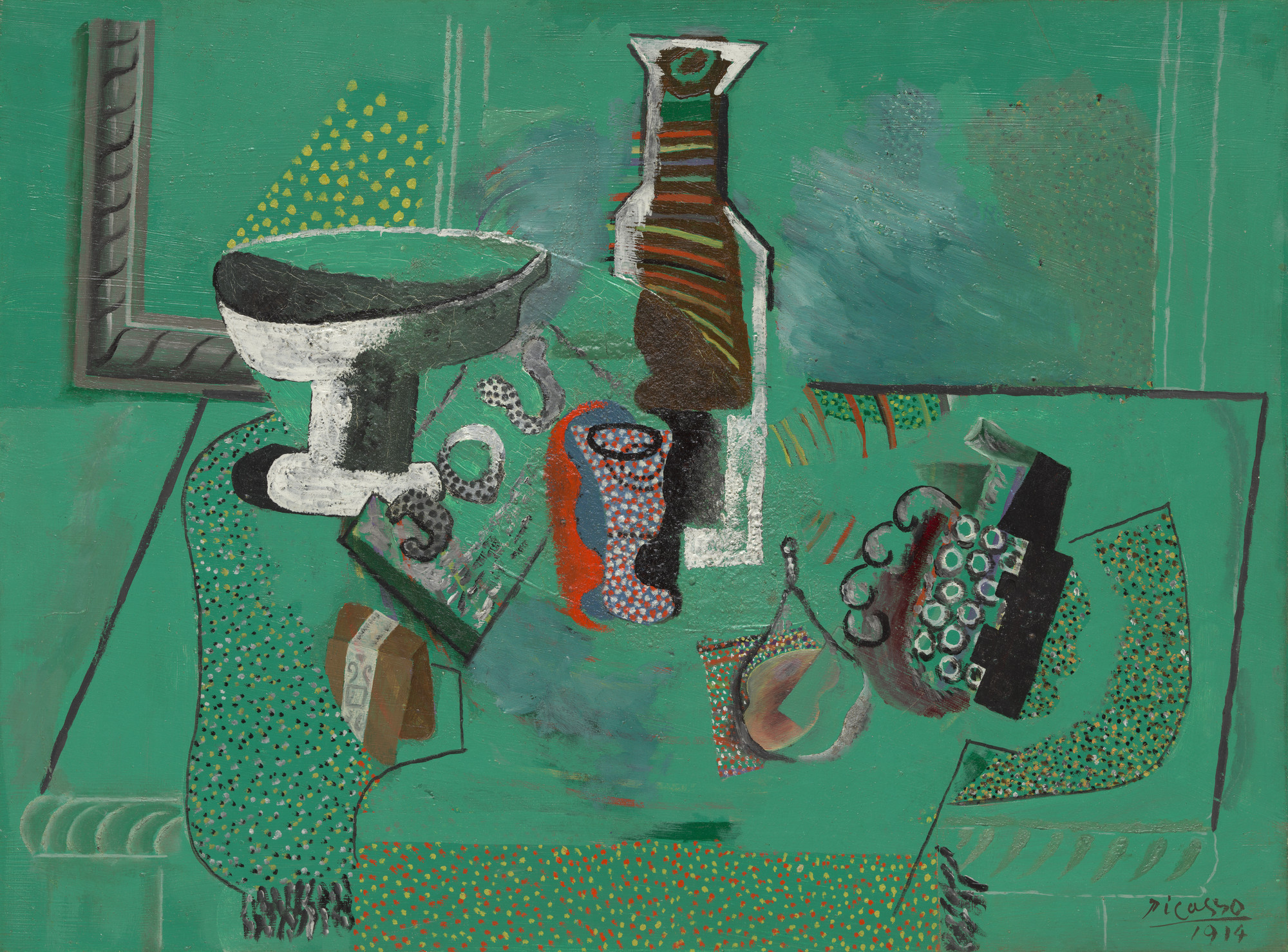
Green Still Life
1914 · same style · similar medium
Guitar and Clarinet on a Mantelpiece
1915 · same style · similar medium
The Studio
1928 · same style · similar medium
Bottle of Bass and Glass
Paris, spring 1914 · same style · similar medium
Shop Related Products
If you love this 1920s masterpiece, explore these curated books and resources on Amazon.
Picasso: A Biography by John Richardson
Comprehensive biography exploring Picasso's life and artistic evolution
Picasso Museum Exhibition Catalogs
Official exhibition catalogs from major Picasso retrospectives
Picasso: A Life Documentary
Comprehensive documentary chronicling Picasso's entire artistic journey
As an Amazon Associate, we earn from qualifying purchases. Each product link is unique to help us track which recommendations resonate most with our visitors.